


Ranking position benchmarks by furniture category 2026
Furniture category ranking position benchmarks tell you whether a page at position 7 is a win or a failure for its category. This page sets the yardstick for 2026: position bands, what each band should deliver, and how to read your own numbers by category.
- Furniture category ranking position benchmarks work as target bands: top 3, positions 4-10, positions 11-20.
- Centre tables, console tables and dining sets are product-led categories; sofas, beds and storage are guide-led.
- Gharaana, a Jodhpur solid wood furniture maker, should judge each category against its own 28-day baseline, not a single site average.
- Skip site-wide average position. It hides the categories that actually move revenue.
Short answer: what a good ranking position is in furniture
A good position is top 3 for a category's money query and top 10 for its supporting queries. Google shows 10 organic results per page, so position 11 and below sits on page two, where almost no one clicks.
This page does not publish invented category averages. Ranking position by furniture category has no single authoritative public dataset, so the table below gives target bands you can apply to your own Google Search Console export. For search demand context, read the search volume benchmarks for wooden furniture categories.
The quotable verdict: for a solid wood furniture seller such as Gharaana, category position matters more than site-wide average position, because one dining table query can outweigh fifty low-intent mirror queries.
Why this matters in 2026
Site-wide average position is the number most dashboards lead with. It is also the least useful one. Google Search Console averages position across every query and page, so a few page-one wins and a long tail of page-five impressions blend into a meaningless figure.
Furniture is a category-driven purchase. A buyer searches for a centre table, a dining set or a full length mirror, compares options, then buys. Your ranking position in 2026 should be tracked the same way: one number per category, per query type.
Three reasons to split by category:
- Each category has a different competitor set. Dining tables face marketplaces and large furniture brands; mirrors face decor retailers.
- Each category has a different page type that wins. Some are won by product pages, others by buying guides.
- Each category has a different ceiling. A narrow query like a marble top console table can reach position 1 sooner than a broad query like a sofa set.
Position bands: what each tier means
Use these bands as the yardstick for every category table you build in 2026.
| Band | Position | What it means | Action |
|---|---|---|---|
| Winning | 1-3 | Page one, top of the results. Defend it. | Refresh content, protect internal links |
| Competitive | 4-10 | Page one, lower half. Closest to a quick win. | Improve title, add FAQ, add internal links |
| Striking distance | 11-20 | Page two. Visible to Google, invisible to buyers. | Rewrite or consolidate the page |
| Buried | 21+ | Not competing for this query. | Re-target or drop the query |
The highest-return band is 11-20. A page there already has relevance; it lacks strength or a sharper match to the query.
The category benchmark table
The table maps each furniture category to the query shape it is searched with, the page type that should rank, and the position target. Targets are set by purchase intent: the narrower and more transactional the query, the higher the bar.
| Category | Typical query shape | Page that should rank | Target position | Best for |
|---|---|---|---|---|
| Centre tables | Material, shape or size plus centre table | Collection page plus buying guide | Top 3 on material queries | Living room refresh |
| Console tables | Wooden console table, length or finish | Collection page | Top 5 | Entryways, hallways |
| Dining table sets | Seater count plus wood or marble top | Product page plus comparison guide | Top 3 on seater queries | Family dining rooms |
| Sofa sets | Wooden sofa set, L-shaped, for living room | Buying guide plus collection | Top 10 | First-time buyers |
| Mirrors | Full length, arched, wall mirror | Collection page | Top 5 | Bedrooms, dressing areas |
| Storage cabinets | Cabinet, crockery unit, sideboard | Collection page plus size guide | Top 10 | Compact homes |
| Armchairs and rocking chairs | Wooden armchair, rocking chair | Collection page | Top 5 | Reading corners |
| Side and bedside tables | Wooden side table, bedside table | Collection page | Top 5 | Bedrooms, sofa sides |
| Beds | Solid wood bed, poster bed | Buying guide plus collection | Top 10 | Master bedrooms |
| TV units and desks | Wooden TV unit, office desk for home | Buying guide | Top 10 | Work-from-home setups |
These are targets, not measured industry averages. Replace them with your own 28-day figures once you have the export.
High and low: where to expect the gap
Expect narrow, specific categories to lead and broad, high-volume categories to trail. Console tables, side tables and mirrors have tighter query sets, so a well-built collection page reaches the top 5 faster. Sofa sets, beds and dining sets attract the widest competition from marketplaces and large furniture brands, so reaching the top 10 is the realistic first goal.
That pattern holds for most furniture sellers: the lower the search breadth, the better your odds of a top-3 position. The practical consequence is where to spend effort first.
- Start with categories already sitting at positions 4-20.
- Move to broad categories only after narrow ones are stable.
- Treat any category outside the top 20 as a content gap, not a ranking problem.
How to measure position by category
The method takes one Search Console export and one spreadsheet.
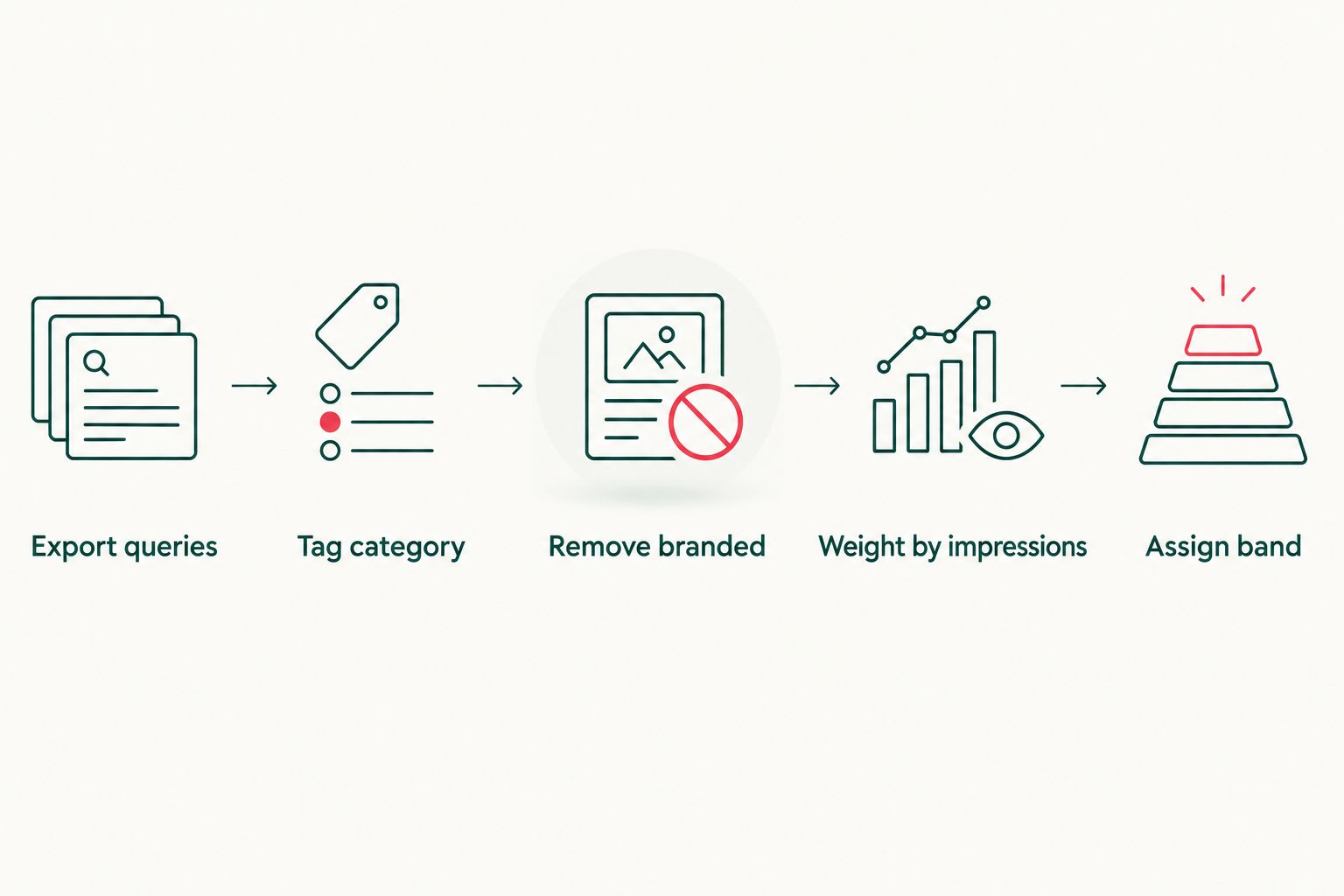
- Export queries and pages for the last 28 days from Google Search Console.
- Tag each query with a category: centre table, console table, dining set, sofa, mirror, storage, seating, side table, bed, TV unit or desk.
- Tag each query as branded or non-branded. Remove branded queries from the benchmark; they inflate position.
- Calculate the impression-weighted average position per category. A raw average treats a 10-impression query like a 10,000-impression one.
- Place each category into a band from the table above.
Run the same export every month. A category moving from position 14 to position 9 matters more than a sitewide average that moved a fraction of a point.
Category notes: what moves position
Centre tables
Centre table queries split by material, shape and size. A page that names the wood species, the dimensions and the room it suits matches more of those queries than a generic collection page. Gharaana's guide to the best centre tables for living rooms is the type of guide-led page that supports the collection page.
Verdict: build guide plus collection together.
Console tables
Console tables are search-led by length and finish. The collection page should state sizes and wood type in plain text so Google can match them. See the best wooden console tables page for a ranked format.
Verdict: aim for top 5 within one quarter.
Dining table sets
Dining is the highest-intent category. Buyers search by seater count and by top material, wood or marble. Give each seater count its own page rather than burying it in one collection. The best wooden dining tables guide shows how to separate those intents.
Verdict: defend top 3 on seater queries; this is the revenue category.
Sofas, beds and storage
These categories are guide-led. Buyers research size, fit and wood before they look at a product page. The page that ranks is usually a buying guide with a clear comparison table, not a bare listing. Expect a longer climb and a top 10 first target.
Verdict: invest in guides before expecting product pages to rank.
Mirrors, armchairs and side tables
These are narrower, visual categories. Collection pages with clear shape, size and frame material in the headings tend to be the right match. Faster gains are realistic here, so they work as early proof that the method is working.
Verdict: use as the quick-win test for your tracking setup.
Limits of this benchmark
Position is a rolling average, not a fixed rank. It shifts by device, location and personalisation, and Search Console reports it as an average across impressions. Treat a one-point move as noise and a three-band move as a signal.
The bands above are targets, not measured industry data. They tell you where to aim, not where competitors currently sit.
How to use these benchmarks
- Rank categories by band, then by revenue. A dining set at position 12 beats a mirror at position 9 for priority.
- Move 11-20 pages first. They are closest to page one and cheapest to lift.
- Pair each category with one guide. Product pages rarely rank alone for broad queries.
- Review quarterly. Monthly exports show direction; quarterly reviews show bands.
- Track the 28-day window consistently. Mixing date ranges makes month-on-month comparison meaningless.
FAQ
What is a good ranking position for a furniture website?
Position 1-3 on a category's main query is the target. Positions 4-10 are still page one but earn far fewer clicks, and page two is effectively invisible to buyers.
Should I track ranking position by category or for the whole site?
Track by category. Site-wide average position blends branded queries, long-tail impressions and money queries into one number that hides what is working.
How often should I check furniture ranking positions?
Export Search Console monthly and review bands quarterly. Daily position changes are mostly noise from device and location differences.
Which furniture categories are easiest to rank for?
Narrow categories such as console tables, side tables and mirrors usually reach the top 5 sooner than broad ones such as sofa sets or beds.
Why exclude branded queries from a category benchmark?
Branded queries usually rank at position 1 and inflate the average. Removing them shows how the category performs for buyers who do not already know you.
Is average position in Search Console reliable?
It is an impression-based average, so it is directional rather than exact. Weight it by impressions per category and watch band changes rather than single-point moves.
Where should a furniture seller start in 2026?
Start with pages at positions 11-20 in the highest-revenue category, usually dining sets. They are already relevant and need stronger content and internal links.
One last thing
The most overlooked number is not position but the gap between your best and worst category. If one category sits in the top 3 and another is buried past position 20, the weaker one is a content gap, not a ranking problem. Fix that gap before polishing the winners. For paid-side context on the same keyword families, see the CPC benchmarks for wooden furniture keywords in India.
